Viewing Domestic Violence Through Poetry
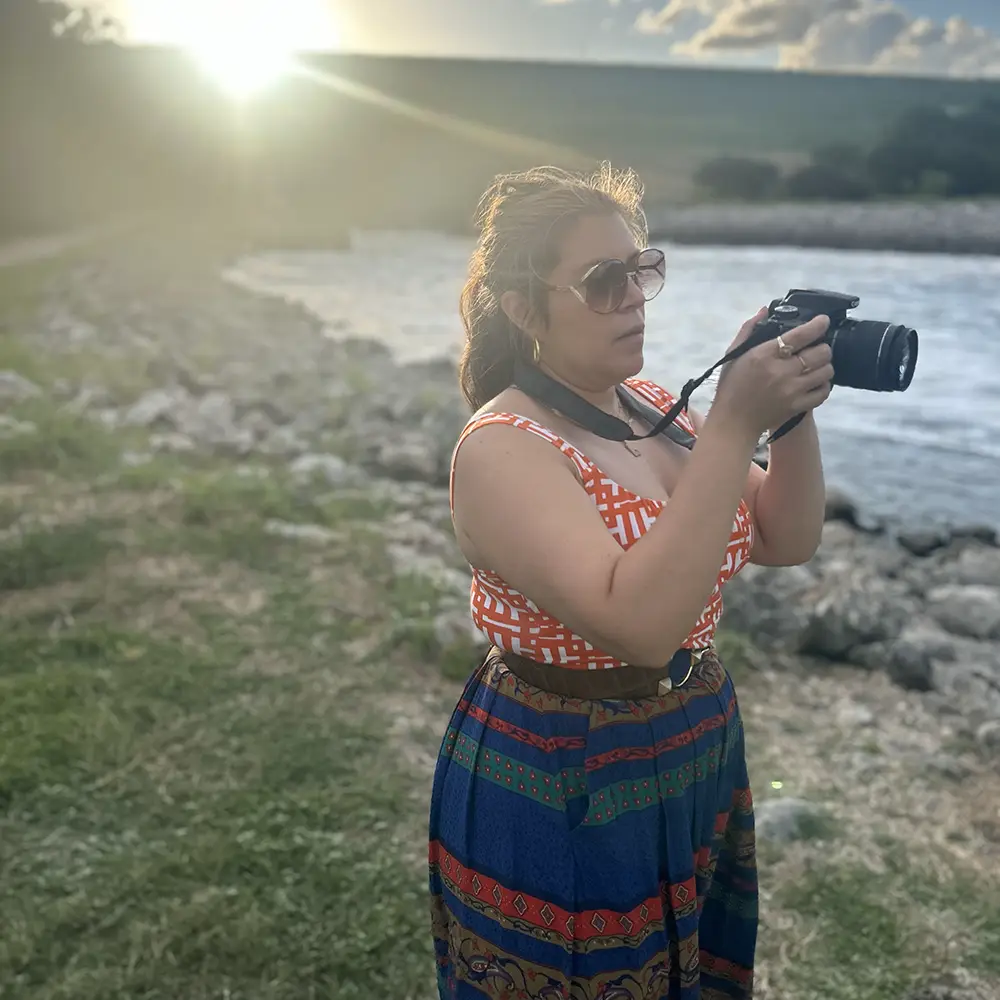
To create her next poetry collection, Iliana Rocha spent almost three weeks this summer conducting what she calls “boots on the ground” fieldwork across Texas. She reviewed police reports, talked to locals, and visited sites where Latinx women had been the victims of domestic violence.
Her research took her to a canal where elementary teacher Irene Garza’s body was recovered in 1960, the gas station parking lot where Gabriella Gonzalez was shot to death in 2023, and the stretch of road where, as a high school student, Rocha experienced a nearly deadly assault.
“In this research I have found what a national crisis it is, this violence against women, and we don’t talk about it,” said Rocha, an assistant professor in the Department of English at the University of Tennessee, Knoxville.
“We treat the violence as normalized, we give it permission, we perpetuate it, and, unfortunately, women’s lives continue to be lost,” she said.
For Rocha’s second book, The Many Deaths of Inocencio Rodriguez (2022) she wrote poems centered on a true crime story involving her grandfather’s death. The poems in her debut, Karankawa, were sparked by the death of an aunt and explored how we reconstruct personal histories.
“I think this is the collection I’ve been trying to write my entire career, and I needed the two previous books to get me here,” Rocha said.
True Crime to Untangling
“I’ve always sort of been obsessed with thinking through true crime and the psychology of what makes people commit these crimes and this type of violence,” she said. Watching television programs allowed her to examine that from a comfortable, safe distance, until she began interrogating the genre.
“Why am I so obsessed with watching Forensic Files before bed and watching every 48 Hours and being drawn to the ones that primarily feature women?” she said. One reason was the unsolved mystery in her family, but there was another. “I had this unreconciled violence in me that I didn’t know how to untangle until very recently,” she said, “and that was through poetry.”
She’s hoping that her new collection will prompt people to reflect about the ways we are complicit in this violence or entertained by it, and that people who have experienced domestic violence will feel a sense of community with her and the other women.
Beyond Words
The idea to add images and sound to the project came after Rocha found photos that a friend snapped of her as a teen, after a former boyfriend punched Rocha in the face and attempted to steer the car into a telephone pole. “I think they are important for me to look at. I think they are important for me to share with other women,” she said of those photos.
Rocha traveled to the road where that assault took place and other crime scenes around Texas.
“It’s ineffable to be in these places, either the canal where Irene was found (in 1960) or the roadside where Vanessa Guillén’s body was disposed of,” she said, referring to the 20-year-old Army soldier killed in 2020. “It lacks explanation, that feeling that I had inside to know how these women were turned from their subjecthood into objects. That’s very hard for me to reconcile.”
But her poetry videos won’t show any of the locations where bodies were found. She is determined not to glorify the violence or make any gratuitous creative choices.
“Being at those places was really transformative for me in my own journey of healing,” she said.
Writing these poems took a physical toll on Rocha and led her to recognize the ways that domestic violence she experienced had impacted her life.
“I thought I had moved past it because I had an ability to intellectualize it through my poetry, however, my physical body has told me otherwise,” she said. “It has been a reconnecting of my head to my heart, which I think has been very separated for a couple of decades now.”
In the Classroom
Rocha’s first book won the 2014 Donald Hall Prize for Poetry and her second the 2019 Berkshire Prize for a First or Second Book of Poetry. In 2024 she received an Outstanding Teacher Award from the UT Alumni Association and a Faculty Innovator Award.
“This is my dream job, to be able to teach poetry and write poetry,” Rocha said.
Growing up as a Mexican American, sometimes the only space she felt safe speaking up was in writing. “I didn’t fit in with the Mexican girls or the White girls, and so I’ve always felt like I’m living in this liminal space of otherness, and I think poetry was created for such an other,” she said.
While she still recalls the trepidation when she first stepped into a classroom as a teacher, she discovered a commitment to being an ambassador of writing. “I’m passionate about poetry and inviting as many people as possible to it . . . I’m really standing up there as poetry’s biggest cheerleader,” she said.
“People are not running to poetry in hordes, like they are supply chain management,” Rocha noted, so she takes it to heart when they come to that creative space. “My hope is that the students can see my excitement and enthusiasm for them being there, for showing up, for taking those big risks in their work, and for also taking their poetry outside of the classroom and doing open mics and readings, and publishing in journals. I have had an incredible experience here with the students at UT.”
(Read Iliana Rocha’s poem “Holy,” inspired by Irene Garza, who was last seen alive when going to confession at a Texas church in 1960. A former priest was convicted of her murder in 2017. )
By Amy Beth Miller