Skillset from English Leads to Local Politics: An Interview with Karyn Adams
English alumna Karyn Adams (ʼ94) sits down with Meghan Pinkston (Class of 2027) to discuss how her time at UT taught her the skills she needed to build a career in business, politics, and more.
Meghan Pinkston: When did you decide that you wanted to pursue a degree in English? What informed that decision?
Karyn Adams: Writing is what I have always done and always wanted to do. From writing a newspaper for my family and plays for classroom work in elementary school, to poetry and fiction throughout middle and high school. To me, pursuing an English degree would give me access to the world of writing—of characters and of ideas—and would give me the freedom to determine exactly what type of writing I felt most strongly about as my studies continued. The exposure to many different types of literature, writing styles, and authors was all part of what the degree would give me. It would be the degree to engage opinions and facts and the area of study that would involve the wrestling between these comfortable zones.
MP: How did your time studying English prepare you for a community-facing position like being on City Council?
KA: If there is a cycle or pattern to studying English, whether it be focused on literature or on creative writing, it is a consistent choreography of reading, then discussing, engaging the text, finding one’s footing, and lastly, articulating one’s perspective and ideas in a way that is illustrative enough to be compelling yet grounded enough to be generative to the field. For me, with a creative writing focus, this meant weekly writing workshops and critiques. These immensely formative exercises taught me how to be vulnerable with my work and ideas, how to receive (and give) constructive feedback, and how just one phrase or word choice can hit people in a multitude of ways. This understanding is a valuable skill to take forward into public service, as is the ability to empathize with varying perspectives and to process and synthesize existing information into novel ideas or innovations.
MP: How has your career journey taken you from being a business owner to a local politician?
KA: I should clarify that I’m still a business owner. It is a misperception that folks serving in City Council or County Commission seats, or other offices, do so as a full time job. Could it be a full time job? Absolutely. But these are typically positioned as a part-time role.
I have always been interested in politics. I remember debating with a classmate in 3rd grade about the presidential election of the time. I can see the through line of politics in my career, from my college job at Tomato Head (we were challenging the status quo, we were being innovative simply by staking claim and seeing value in a part of the city that had been forgotten, we were witnessing how to be true to yourself and your passions and lead in a fair and inclusive way—thanks, Mahasti Vafaie!); to my work at Omniview/IPIX in high tech where we had the challenge of growing a business and taking it public while being ever mindful of our community and business partnerships; to my time at Maryville College, where I first learned the phrase “town/gown relationship,” collaborated on the public/private partnership that led to the Clayton Center for the Arts, and came to understand how a campus is very much a small city, with its own constituents, competing demands for budget, and shared governance. When I founded my own business, I took all of these lessons and learnings forward, and they informed my work as I served on boards and community groups.
I was first asked to run for local office about 15 or so years ago. I was flattered, and tempted, but ultimately declined because it felt like the wrong time. My kids were quite young then and this was long before remote work was a common option. I didn’t see how I could make it all work. But the ask was what stuck with me. Someone else, someone who I respected and valued, saw in me the potential to serve my community in an effective way. It made me realize that my innate interest was also something that others could see as potential ability. I was asked a few more times (and kept declining) but fed the desire by learning as much as I could—from participating in the Citizen’s Academy which teaches folks about the ins and outs of running for office to helping support other candidates for Mayor, City Council, and County Commission. I also accepted the appointment of Planning Commissioner for the City of Knoxville. This role was indispensable to my growing knowledge of planning, zoning, and development and gave me real world experience in wrestling with the thorny issues of land use. These experiences and perspectives helped me broaden my perspectives and my leadership abilities, showing me how critically important it is to be engaged with the public process.
When then Vice-Mayor and District 1 City Councilman Tommy Smith asked me if I would consider running, I thought long and hard, but I was ultimately able to answer him with a yes. The time finally felt right from a life stage standpoint and it definitely felt right from the vantage of personal goals. This is something I had always wanted to do, and District 1—South Knoxville and Fort Sanders—is where I have lived and played and dreamed and grown for most of my adult life. It’s time for me to give back to the community and city—through ideas, through progress, and through inclusion and innovation.
MP: Are there any English classes you recall being particularly memorable from your time at the University of Tennessee?
KA: The African American Literature class that gave me early Toni Morrison—The Bluest Eye, Jazz, Song of Solomon— and the artful way that professor dealt with some interesting situations in class was one. A period literature class, taught by an African professor, that centered on Mark Twain’s Huck Finn. He was able to crack open the text from an incredibly unique outsider perspective that felt so illuminating and free from the standard textual analysis. He was the first professor who forced me to argue for a point that I didn’t agree with, helping me discover the importance of changing one’s lens to expand their view. It was a literary criticism class that taught me how to interrogate a text through numerous systems of analysis and thought. All of these were powerful experiences that taught me how to think. Not what to think, not what to believe, but how to critically think about my ideas and how to articulate them to others. Isn’t this the most important aspect of education, no matter the field?
The professors are the people who bring this content to life and help connect each student with the material in a way that works. Art Smith is, frankly, why I am in Knoxville. I had planned on being here only one semester, but when I took his poetry class I knew I had found my mentor. He challenged me in so many ways, and supported me through what I think is one of the most important—and difficult—times of life. He helped me find my place in my own writing and in my writing community. It was a great honor to get to talk with Linda Parsons, the City of Knoxville’s Poet Laureate, at my swearing-in ceremony. I shared my story with her, and as soon as I mentioned Art’s name, she had the same reaction of warm appreciation. He was a wonderful writer, teacher, and friend, and I am forever grateful for him showing me that poetry is where I can find truth, questions, solace, beauty, new perspectives, and answers.
MP: What advice would you give to current English majors preparing to enter the workforce?
KA: You need to know that if you have studied English and taken your coursework and classroom experiences for all they are worth, you have what you need. You have the ability to gather and synthesize, you have the skill of empathy and critique, you understand people, motivations, and you know how to communicate. These are the tools that you will need, in every role you will have from here forward. It is different than writing a paper or presenting in class, true, but the core skills are there and you already know how to synthesize (seemingly) disparate concepts. You will be tasked with connecting the dots for your hiring managers, showing them and proving to them why you have a deeper skill set than others because of your studies. Don’t let that scare you, take it as the challenge it is to create—make the path that you want to take.
MP: What advice would you give to students looking to pursue a career in politics?
KA: First of all, vote. In every election. The local ones are honestly way more important than the big national ones that get all the attention. If you haven’t changed your home address to Knoxville, then vote in your hometown election via absentee ballot. Vote. And if you don’t know who to vote for, don’t feel ashamed to ask someone you trust about their opinion and why. Do as much of your own research as you can, ask others, attend candidate events and always vote. If you are doing these things, you’re going to get exposed to people and ideas that inspire you, that tap into things that you want to move forward or you want to change. Follow those passions. Meet with people. All the people. Go to meetings—public ones, neighborhood ones, virtual ones, and especially in-person ones—and pay attention to who you start to see showing up at these same meetings. One of the greatest assignments that Art Smith gave, to all of his classes (whether undergraduate or graduate level) was to attend readings and write down what you saw. Not what was read or an analysis of the writing being shared, but simply what you saw. This simple act of learning to pay attention to what may seem surface-level, and the critical thinking that kicks in to ask what is happening just below the surface, is incredibly instructive. Go door knocking for candidates you like, get to know them and ask about their ideas or share a problem you think is important to be addressed. And if you didn’t hear me say it the first time, vote.
MP: What skills did you gain as an English major that have extended into your professional life?
KA: Being able to give and receive criticism. Being able to focus on the goal (e.g. thesis) and not get distracted by other demands (e.g., competing ideas or alternative project ideas). Being able to argue and see a different perspective. The ability to gather, to consider, to learn and get more information than I think necessary, and then synthesize it into a cohesive idea and movement. And of course, at the beginning of every day, and throughout the intensities of professional demands, to find my grounding in poetry and in writing.
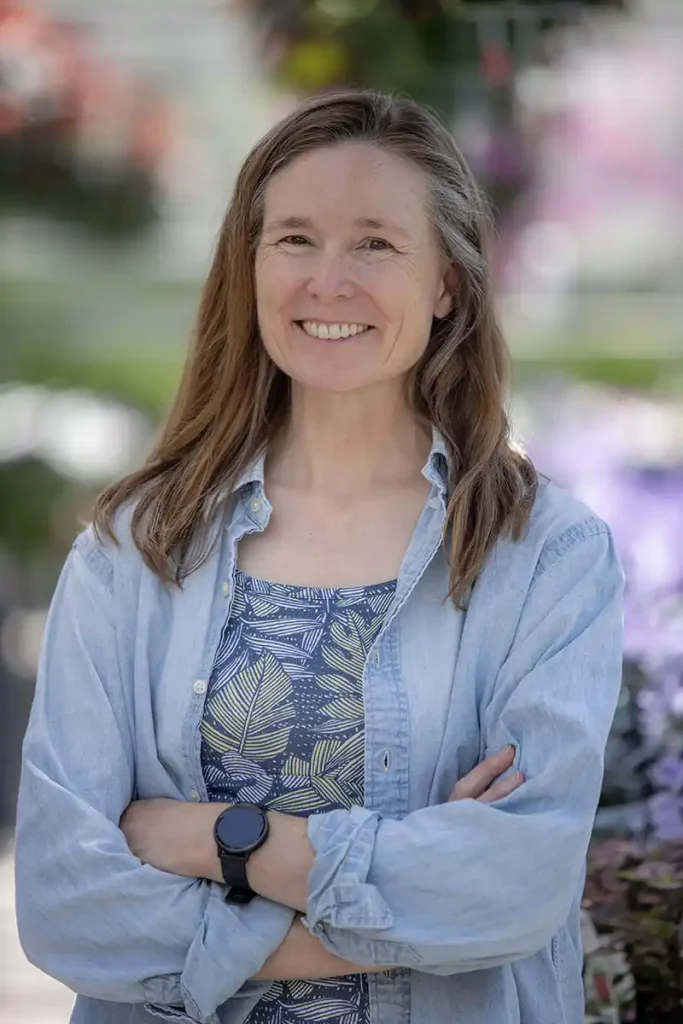
Karyn Adams (‘94) is a mother, spouse, runner, cyclist, writer, business owner, Knoxville City Council member, neighborhood advocate, and connector-of-dots. She believes in the power of community and a great quality of life through smart, sustainable growth. Adams moved to Knoxville in the early nineties after attending Agnes Scott College in Decatur, GA. She continued her studies at the University of Tennessee – Knoxville. After working in high tech and higher ed, she founded HA ThirtyOne in 2011, a higher ed strategy + marketing + communications company. She serves as the firm’s Principal and Creative Director. In addition to her work on Council and with HA ThirtyOne, Adams has published works in the genres of travel, food, poetry, and higher ed. She resides in Knoxville with her spouse, Bruce Cole, and her sons, Auden and Crispin.
Meghan Pinkston (Class of 2027) is a Knoxville native pursuing a BA in English at the University of Tennessee with plans to attend law school after graduating. She works as a consultant in the Judith Anderson Herbert Writing Center and enjoys getting to share her love for reading and writing with other students. When she is not in the library, you can find her going to concerts, scuba diving, and watching bad sitcoms.